Published
- 4 min read
CPE161 Week 8 Continue && Break
Continue && Break
In C programming, continue and break are control flow statements used within loops (for, while, do-while) to control the flow of execution.
Continue
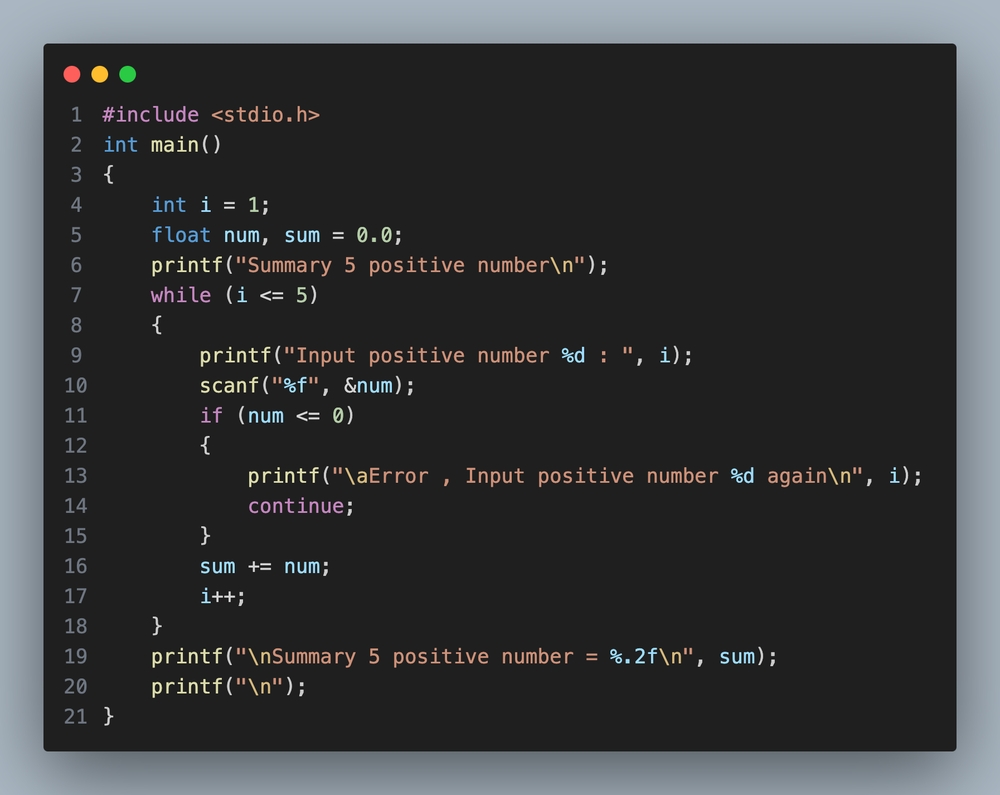
The continue statement is used to skip the remaining code in the current iteration of a loop and move directly to the next iteration. This means that when continue is executed, the rest of the code within the loop body for that iteration is bypassed, and the loop proceeds with the next iteration.
Project 1
       #include <stdio.h>
int main()
{
    int i = 1;
    float num, sum = 0.0;
    printf("Summary 5 positive number\n");
    while (i <= 5)
    {
        printf("Input positive number %d : ", i);
        scanf("%f", &num);
        if (num <= 0)
        {
            printf("\aError , Input positive number %d again\n", i);
            continue;
        }
        sum += num;
        i++;
    }
    printf("\nSummary 5 positive number = %.2f\n", sum);
    printf("\n");
}
Output :
       Input positive number 1 : 1
Input positive number 2 : 2
Input positive number 3 : 3
Input positive number 4 : -4
Error , Input positive number 4 again
Input positive number 4 : 4
Input positive number 5 : 5

Summary 5 positive number = 15.00
Break
The break statement is used to exit the current loop immediately, regardless of the loop’s condition. When break is executed, it terminates the loop and control is transferred to the statement immediately following the loop.
Project 2
       #include <stdio.h>
int main()
{
    int i = 1;
    float num, sum = 0.0;
    printf("Summary 5 positive number\n");
    while (i <= 5)
    {
        printf("Input positive number %d : ", i);
        scanf("%f", &num);
        if (num <= 0)
        {
            printf("\aError , Input positive number %d again\n", i);
            break;
        }
        sum += num;
        i++;
    }
    printf("\nSummary 5 positive number = %.2f\n", sum);
}
Output :
       Summary 5 positive number
Input positive number 1 : 1
Input positive number 2 : 2
Input positive number 3 : 3
Input positive number 4 : -4
Error , Input positive number 4 again

Summary 5 positive number = 6.00
Project 3
       #include <stdio.h>

int main() {
    int i = 1, j;
    printf("\n");
    while (i <= 12) {
        j = 1;
        while (j <= 12) {
            printf("%d\t", j * i);
            j++;
        }
        printf("\n");
        i++;
    }
    printf("Thank you .");
    return 0;
}
Output :
       1       2       3       4       5       6       7       8       9       10      11      12
2       4       6       8       10      12      14      16      18      20      22      24
3       6       9       12      15      18      21      24      27      30      33      36
4       8       12      16      20      24      28      32      36      40      44      48
5       10      15      20      25      30      35      40      45      50      55      60
6       12      18      24      30      36      42      48      54      60      66      72
7       14      21      28      35      42      49      56      63      70      77      84
8       16      24      32      40      48      56      64      72      80      88      96
9       18      27      36      45      54      63      72      81      90      99      108
10      20      30      40      50      60      70      80      90      100     110     120
11      22      33      44      55      66      77      88      99      110     121     132
12      24      36      48      60      72      84      96      108     120     132     144
Thank you
Project 4
       #include <stdio.h>
void main()
{
    int i, j;
    for (i = 1; i <= 5; i++)
    {
        for (j = 1; j <= i; j++)
        {
            printf(" * ");
        }
        printf("\n");
    }
}
Output :
        *
 *  *
 *  *  *
 *  *  *  *
 *  *  *  *  *
Project 5
       #include <stdio.h>

int main() {
    int i, j;
    for (i = 5; i >= 1; i--) {
        for (j = 1; j <= i; j++) {
            printf(" * ");
        }
        printf("\n");
    }
    return 0;
}
Output :
        *  *  *  *  *
 *  *  *  *
 *  *  *
 *  *
 *