Published
- 2 min read
CPE161 Week 12 Pointer
Pointer
In C, a pointer is a variable that stores the memory address of another variable, allowing direct memory manipulation.
Project 1
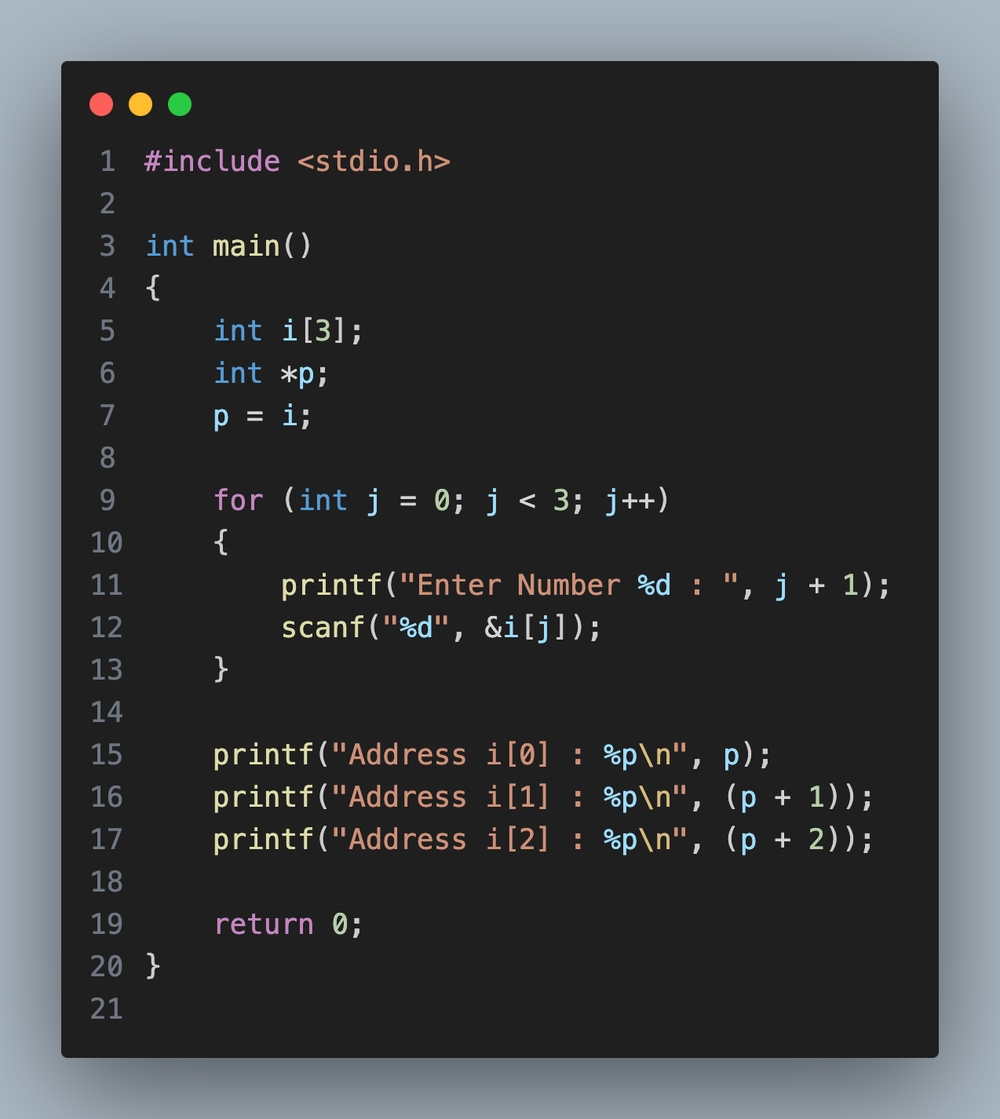
       #include <stdio.h>

int main()
{
    int i[3];
    int *p;
    p = i;
    for (int j = 0; j < 3; j++)
    {
        printf("Enter Number %d : ", j + 1);
        scanf("%d", &i[j]);
    }
    printf("Address i[0] : %p\n", p);
    printf("Address i[1] : %p\n", (p + 1));
    printf("Address i[2] : %p\n", (p + 2));
    return 0;
}
Output :
       Enter Number 1 : 10
Enter Number 2 : 20
Enter Number 3 : 30
Address i[0] : 0x16b7a70bc
Address i[1] : 0x16b7a70c0
Address i[2] : 0x16b7a70c4
Project 2
       #include <stdio.h>
int main()
{
    int number[5] = {10, 20, 30, 40, 50};
    int *myPointer = &number[0];
    printf("first -> %d\n",
           *myPointer);
    myPointer++;
    printf("go next -> %d\n",
           *myPointer);
    myPointer += 3;
    printf("go next 3 -> %d\n",
           *myPointer);
    myPointer--;
    printf("go back -> %d\n",
           *myPointer);
    return 0;
}
Output :
       first -> 10
go next -> 20
go next 3 -> 50
go back -> 40
Project 3
       #include <stdio.h>
void change(int *px, int *py)
{
    *px = 5;
    px = py;
}
int main()
{
    int x = 0;
    int y = 1;
    int *px = &x;
    int *py = &y;
    change(px, py);
    *px = 2;
    printf("(x, y) = (%d, %d)\n", x, y);
}
Output :
(x, y) = (2, 1)Project 4
       #include <stdio.h>
void change(int *px, int *py)
{
    px = py;
    *px = 5;
}
int main()
{
    int x = 0;
    int y = 1;
    int *px = &x;
    int *py = &y;
    change(px, py);
    *px = 2;
    printf("(x, y) = (%d, %d)\n", x, y);
}
Output :
(x, y) = (2, 5)