Published
- 2 min read
CPE161 Week 4 Format Specifiers in C language
In C, format specifiers are used in functions like printf and scanf to define the type of data being processed. Here are some commonly used format specifiers:
Format Specifiers
For scanf (input):
- %d: Read an integer
- %i: Read an integer (with base determined by the input)
- %u: Read an unsigned integer
- %f: Read a floating-point number
- %lf: Read a double-precision floating-point number
- %c: Read a single character
- %s: Read a string of characters (until whitespace is encountered)
- %x or %X: Read an unsigned integer in hexadecimal
- %o: Read an unsigned integer in octal
For printf (output):
- %d or %i: Integer (decimal)
- %u: Unsigned integer
- %f: Floating-point number (decimal notation)
- %lf: Double-precision floating-point number
- %c: Single character
- %s: String of characters
- %x or %X: Unsigned integer in hexadecimal (lowercase/uppercase)
- %o: Unsigned integer in octal
- %p: Pointer address
- %e or %E: Floating-point number in scientific notation
Modifiers:
- %hd: Short integer
- %ld: Long integer
- %lld: Long long integer
- %hhd: Signed char (short)
- %.2f: For 2 floating-point values (precision can be adjusted with .nf where n is the number of decimal places)
Week 3
Project 1
       #include <stdio.h>
int main()
{
    int a;
    a = 555;
    printf("%d\n", a);
    printf("%4d\n", a);
    printf("%6d\n", a);
    printf("%8d\n", a);
}
Output :
       555
  555
    555
      555
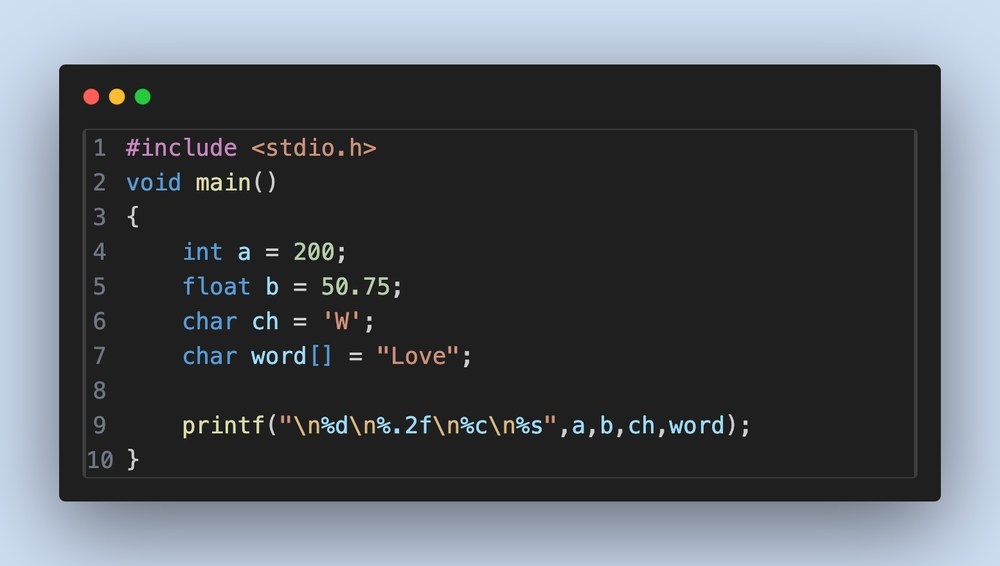
Project 2
       #include <stdio.h>
void main()
{
    int a = 200;
    float b = 50.75;
    char ch = 'W';
    char word[] = "Love";

    printf("\n%d\n%.2f\n%c\n%s",a,b,ch,word);
}
Output :
       200
50.75
W
Love
Project 3
       #include <stdio.h>
void main()
{
    int a, b, c, sum;
    printf("Enter number 1:");
    scanf("%d", &a);
    printf("Enter number 2:");
    scanf("%d", &b);
    printf("Enter number 3:");
    scanf("%d", &c);
    sum = a + b + c;
    printf("a + b + c = %d", sum);
}
Output :
       Enter number 1:1
Enter number 2:2
Enter number 3:3
a + b + c = 6